
Your ICP Hasn't Changed. Their Question Has — and That's What You're Missing.
I once watched a CRM flag the same prospective student twice — once in January, once in May — as two nearly identical leads. Same name, same course interest, same demographic profile. The system routed both enquiries into the same nurture sequence, with the same messaging about career outcomes and placements.
The January enquiry was someone still deciding whether this field was even right for them. The May enquiry was someone comparing this institution against two others they'd already shortlisted, weeks from a decision. The CRM was technically correct — it was the same person. It had no way of knowing it was talking to two entirely different people having two entirely different conversations in their own head.
The Audience Didn't Change. The Question Did.
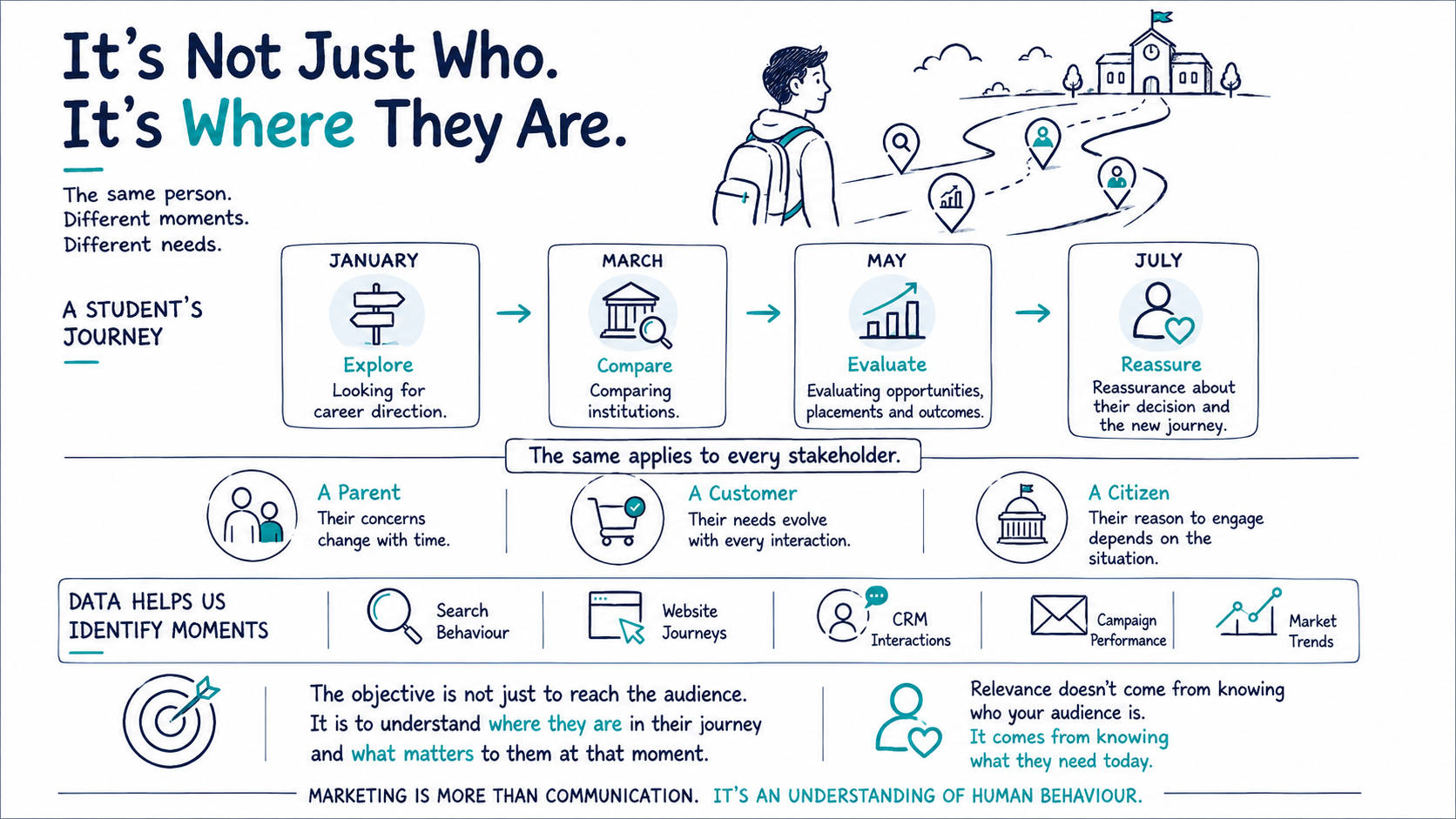
Most targeting work stops at answering "who is my audience" — the ICP, the persona, the demographic and psychographic profile. That work matters, but it answers a question that stays fixed for months while the person behind it keeps moving. A student exploring higher education in January is asking about career direction. By March, they're comparing institutions. By May, they're weighing placements and outcomes. By July, after the decision is made, they're looking for reassurance that they chose correctly.
It's the same person, correctly identified, correctly targeted — and served the wrong message at every single one of those points, because the targeting logic only ever asked who they were, never what they needed today.
The Hidden Pattern: We Built Systems to Identify People, Not Moments
This isn't a data problem in the sense of missing information — most organisations already have search behaviour, website journeys, CRM interactions, and campaign performance sitting in their systems. It's an architecture problem. Marketing infrastructure was built around the audience as the stable unit of targeting, because audience is easy to define once and reuse indefinitely. A moment has to be re-read constantly, which is expensive, so most systems quietly default back to audience as a proxy for relevance and hope it's close enough.
It usually isn't. Decision science has a name for this: people are state-dependent — the same individual, with the same underlying profile, will weigh the identical piece of information completely differently depending on where they are in a decision. Treating audience as the primary targeting variable and moment as a secondary refinement gets the hierarchy backwards. The audience tells you who might listen. The moment tells you what they'll actually hear.
Where This Shows Up Beyond Education
A bank sees the same customer twice a year, driven by nothing more than the calendar. In March, that customer is searching for tax-saving investment options — ELSS funds, insurance, deductions before the financial year closes. In October, the same customer is searching for a personal loan or a credit line increase ahead of the festive season. Same person, same relationship with the bank, completely different financial mindset — one is about optimising savings under a deadline, the other is about funding spending under a different kind of pressure. A bank that emails both moments with the same generic "manage your finances better" message is technically reaching the right customer and saying nothing relevant to either version of them. A SaaS company runs into a version of the same problem with the same account logging in during a free trial versus a year later near renewal — same user, but one is evaluating whether the product solves their problem, the other is deciding whether it's still worth the price. In every case, the identity is stable and the relevance is not.
What This Changes About How Relevance Gets Built
The practical shift isn't discarding audience definition — it's still the necessary first filter. The shift is treating moment as a second, equally deliberate layer of targeting, built from the same data most organisations already collect but rarely re-read at each touchpoint: what was this person searching for this time, what page did they land on this time, what did they actually ask the counselling or sales team this time. That's the signal that tells you which version of the message to send, not the static profile sitting in the CRM from the first enquiry.
Relevance was never only a function of knowing who someone is. It's a function of knowing what they need today — and today is the one thing an audience definition can never tell you on its own.