
Why "That's Not Possible Yet" Is the Wrong Reason to Kill a Marketing Idea
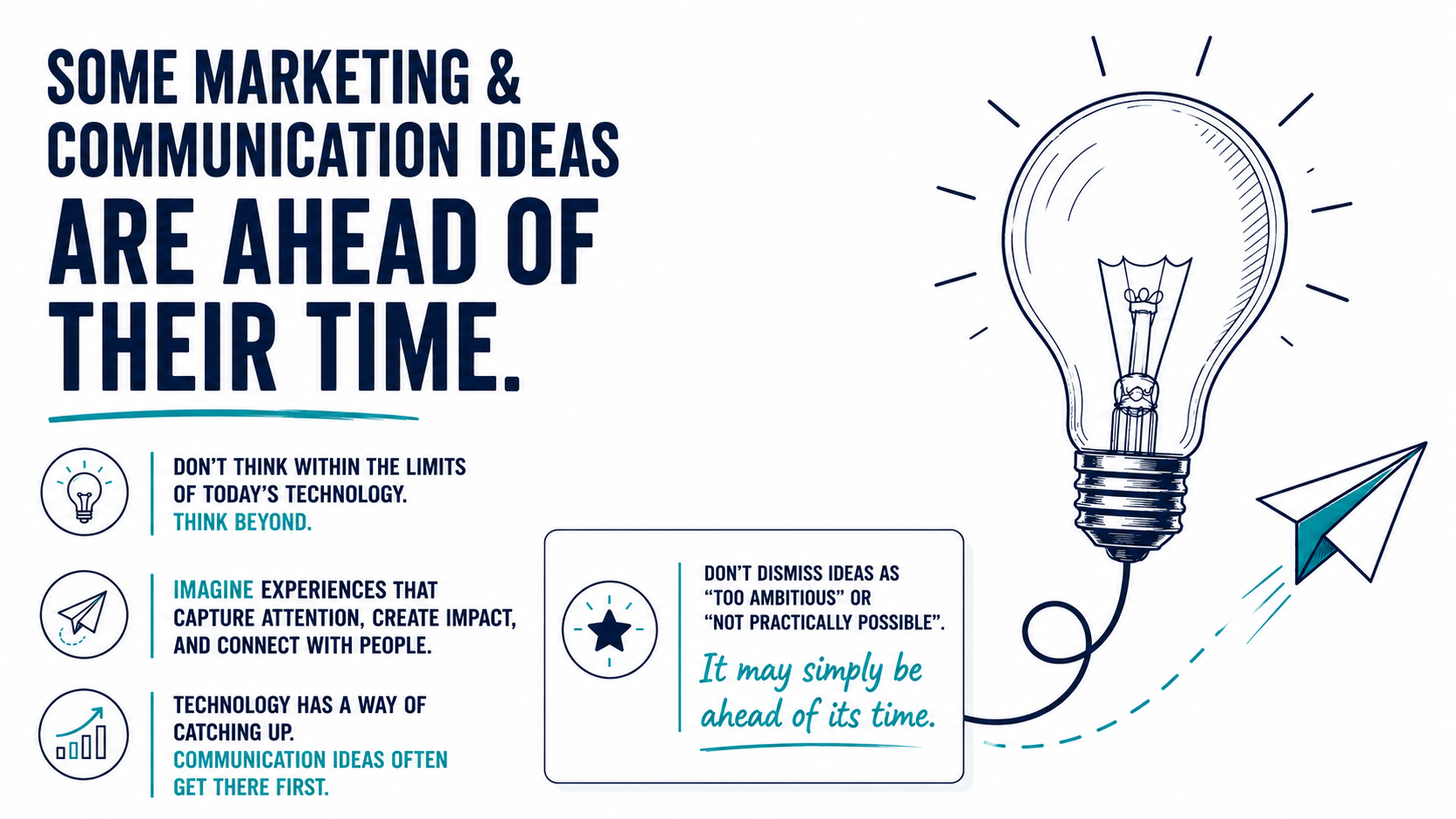
In 2017, during the early brainstorming for DigiThane, someone in the room floated an idea that felt more like science fiction than a campaign plan: what if, at a predetermined moment, every mobile phone across Thane rang at once, and everyone looked down to see a single message — DigiThane. Not a notification sent to a list. A shared communication experience, felt by an entire city in the same second.
Everyone in the room liked it. Nobody could build it. The infrastructure to synchronise a message across every device in a city, at that moment, simply didn't exist for a marketing campaign to use — so it stayed on the whiteboard and the meeting moved on.
Nine years later, on an ordinary afternoon in Maharashtra, offices paused mid-conversation as an emergency heatwave alert landed on millions of phones at exactly the same moment. I watched people reach for their phones in unison and felt an odd, specific recognition — not because it was the same campaign, but because it was the exact communication experience that had been sketched on a whiteboard nine years earlier, waiting for the world to catch up to it.
The Idea Wasn't Wrong. The Infrastructure Was Late.
It's tempting to file the 2017 version of that idea under "too ambitious" and move on — a fun thought experiment that never had a real chance. But that's not actually what happened. The idea correctly identified something true about human attention: a message experienced simultaneously by an entire population creates a psychological weight that a message trickling into individual feeds never can. What was missing in 2017 wasn't the insight. It was the delivery mechanism to act on it at that scale, on demand, for a private campaign.
This is a distinction most teams collapse into one judgment. An idea gets rejected as "not possible," and the room quietly treats that as evidence the idea itself was flawed — when often the idea was correct and only the supporting technology was unfinished. Those are two entirely different failure modes, and only one of them should end the conversation.
The Hidden Pattern: We Evaluate Ideas Against Today's Constraints, Not Against Human Behaviour
Most idea evaluation in marketing quietly asks one question: can we build this right now, with what we currently have? That's a reasonable operational question. It is a poor filter for whether an idea deserves to exist, because it measures the idea against the shelf life of current technology instead of against something far more stable — how people actually pay attention, form memory, and respond to shared experience.
Technology constraints move. Human attention patterns move far more slowly. An idea built on a genuine insight about attention or behaviour tends to survive the wait; an idea built only on a novel use of a specific technology tends to expire the moment that technology becomes ordinary. The mistake isn't dreaming too big. It's judging the idea by the wrong clock.
This Shows Up Everywhere Infrastructure Lags Insight
The same gap appears wherever communication or product ideas outrun the systems meant to deliver them. Specialty chemical companies have pitched customised, real-time formulation dashboards to clients years before the data infrastructure existed to support one. SaaS product teams have designed collaborative features that waited on browser or network capability to actually ship. Even government citizen-engagement programmes routinely design experiences — real-time grievance tracking, unified city dashboards — years ahead of the digital penetration needed to deliver them at scale. In each case, the idea wasn't wrong. It was simply early, filed away until the surrounding ecosystem caught up.
What This Changes About How Ideas Get Shelved
The practical shift is in the question asked before an ambitious idea gets killed. Instead of "can we build this today," the sharper question is: is this idea correct about how people will respond, independent of whatever technology it currently requires? If the answer is yes, the idea deserves to be filed and revisited, not discarded — because the constraint standing in its way is the part of the equation most likely to change.
Communication ideas, at their best, aren't predictions about what technology will allow. They're observations about what people already want, waiting for the infrastructure to catch up to them.