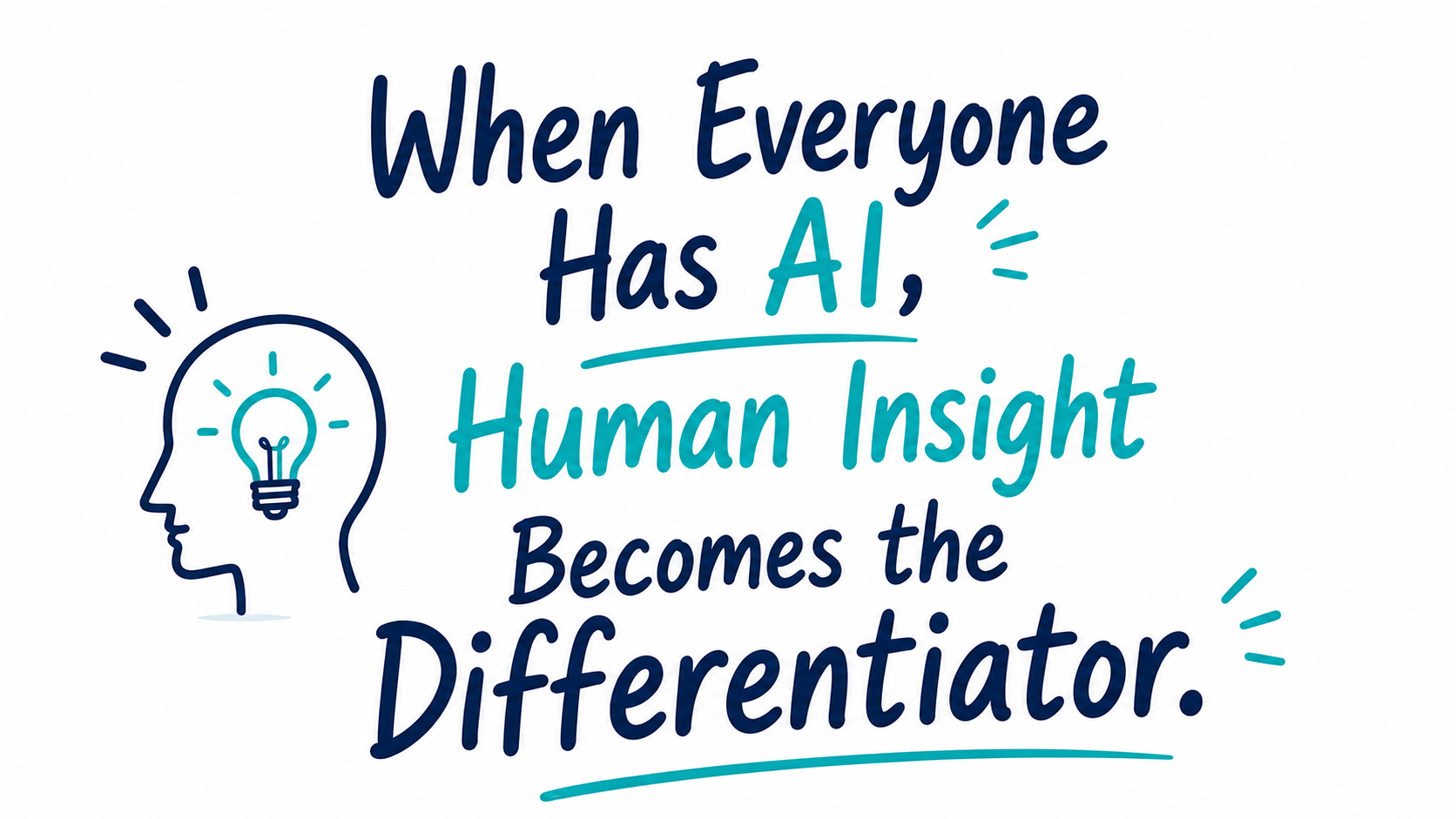
When Everyone Has AI, the Advantage Shifts From Creating Content to Knowing What to Say
I've started noticing something across the drafts clients and colleagues now share for review. They read well. They're organised, grammatically clean, on-brief. And increasingly, several of them, across entirely different clients, are reaching for the same underlying observation — different logos, same argument, same structure, same conclusion.
That's not a sign the tools are bad. It's a sign of what's actually scarce now. When execution becomes nearly free, the thing that separates one campaign from another was never going to be how fast it was produced.
AI Can Write the Message. It Cannot Discover Which Message Is Right.
The conversation around AI in marketing usually starts with a production question: how do we create more content, faster. AI has genuinely answered that. It can generate ideas, write drafts, produce multiple campaign versions, and analyse volumes of data no team could process manually.
But communication was never only about producing a message. It was always about discovering the right one — understanding what an audience actually needs, what context sits behind their behaviour, what will make them care, what action is actually worth asking for, and just as often, what shouldn't be said at all. That discovery work has never come from a tool. It comes from observation, lived experience, and judgment — the parts of the job that were never actually about typing words onto a page.
The Hidden Pattern: Execution Was Never the Bottleneck. It Just Looked Like One.
For years, production speed and strategic clarity were bundled together, because producing content was slow and expensive enough that it masked a simpler truth: most of the real work happened before a single word was written. AI has now stripped the production layer away almost entirely, and what's left standing, fully exposed, is the question that was always the harder one — do we actually know what needs to be said.
This is why human insight isn't becoming more important as a reaction to AI. It's becoming more visible. It was always the part of the job that determined whether a campaign worked. It's simply no longer hidden behind weeks of production time that made it easy to mistake speed for strategy.
Why the Insight Itself Has to Come From Outside the Tool
A useful way to see this: AI is trained on everything that's already been published, said, and written down. It's extraordinarily good at recombining that into a fluent draft. What it cannot do is generate an observation that was never written down anywhere — the pattern noticed in a boardroom, on a factory floor, in a counselling call, in a stakeholder meeting, that exists only in the memory of the person who was actually there. That observation is the raw material insight is built from, and it's the one input no model has access to, however well it's prompted.
A student admission campaign, a citizen engagement initiative, and a corporate brand programme can all run through identical AI tools and still need entirely different underlying insight — not because the content format changes, but because the human context behind each one is different, and that context has to be supplied by someone who actually understands it firsthand.
Where This Shows Up Beyond Marketing Content
The same principle holds wherever a discipline separates execution from direction. A specialty chemicals firm can use AI to draft technical content instantly, but knowing which technical concern actually worries a procurement committee still comes from someone who has sat across the table from one. A SaaS team can generate blog posts at scale, but knowing which unspoken objection is actually stalling renewals comes from someone who has sat in on the churn conversations. A government communication team can draft citizen messaging faster than ever, but knowing what a specific community actually needs to hear still comes from someone who has stood in that community and listened. In every case, AI compresses the distance between an insight and a finished message. It has no way of generating the insight itself.
What This Changes
The practical shift is in where time and hiring priorities go. For years, marketing organisations were built around production capacity — more writers, more designers, more hands to execute. That capacity is no longer the constraint. What's scarce now is observation capacity: people who've spent enough real time inside the actual context — the boardroom, the factory, the counselling call, the campaign that didn't work — to notice something true that hasn't been said yet.
AI will keep making execution faster for everyone, equally. It will never manufacture the one thing that was always the actual differentiator. The future of marketing belongs to whoever can pair a genuine human insight with AI's speed of execution — and increasingly, the insight is the harder half to find.