
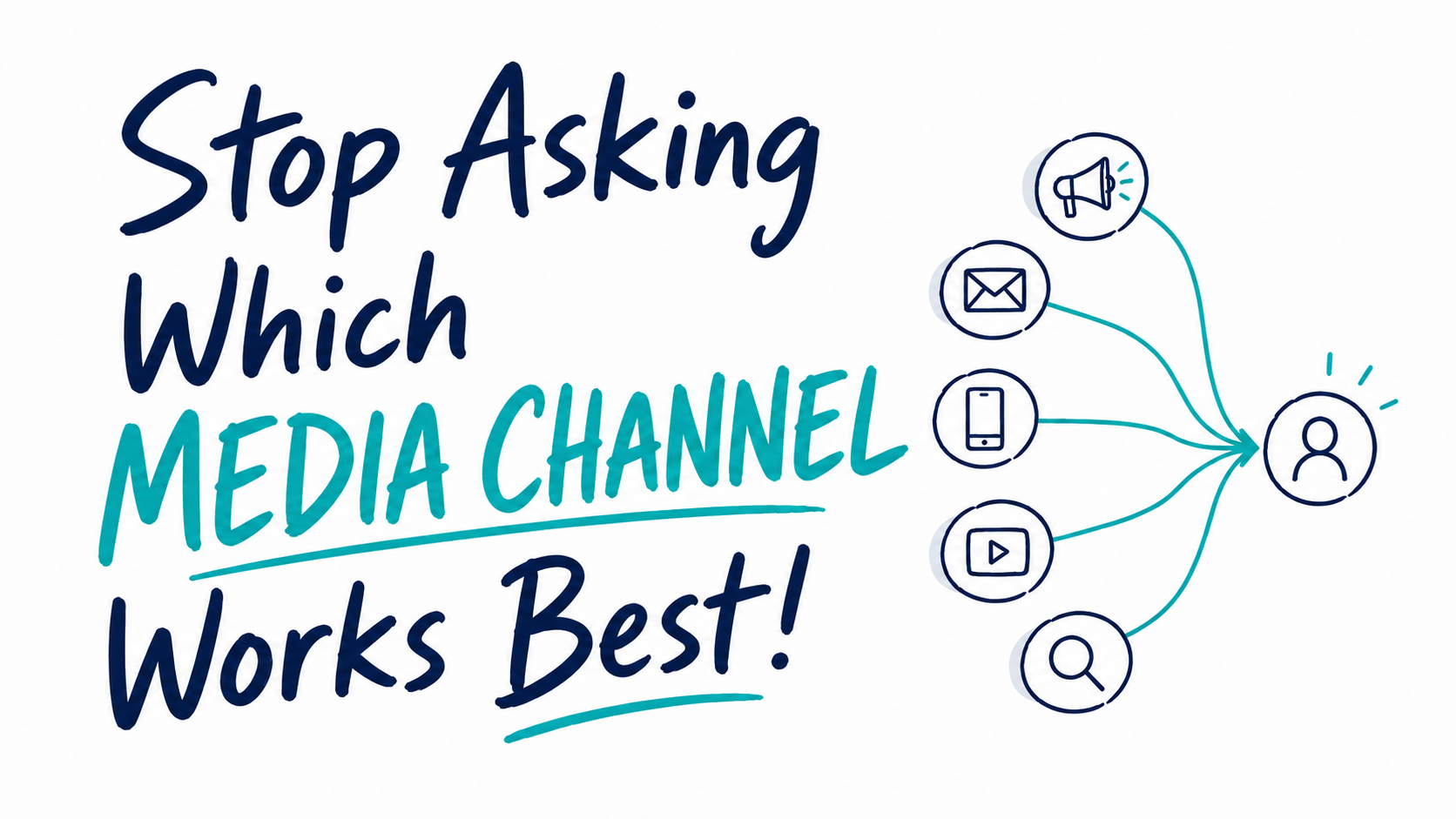
Stop Asking Which Channel Performs Better. They Were Never Playing the Same Game.
A few years ago I bought a flat, and I genuinely cannot tell you which advertisement convinced me — because it wasn't one. A hoarding I passed daily made me aware of the project. Weeks later, the same developer started appearing on social media, keeping the project in the back of my mind. Curiosity eventually took over: I googled the project, visited the website, checked floor plans, explored the location on Maps, watched YouTube walkthroughs, read reviews, asked friends who knew the area, visited the sample flat, met the sales team, compared it against other projects, and discussed it with my family. Only after all of that did I decide.
Looking back, no single medium sold me the flat. But more importantly, no single medium was ever trying to. The hoarding wasn't competing with the sample flat visit to "convert" me. They weren't even attempting the same job.
Each Channel Has a Different Motive, Not a Different Efficiency Rating
Most media conversations treat channels as competitors running the same race — Google versus Meta, outdoor versus digital, whichever one "performs better" earns the bigger share of budget. That comparison only makes sense if every channel is trying to accomplish the same thing. They aren't.
The hoarding had one job: create awareness in a mind that wasn't looking for a flat yet. Social media had a different job: keep the project present once curiosity had been triggered, without demanding an active decision. Google search had a different job again: validate that this was worth a closer look, at the exact moment I was actively deciding to investigate. The website answered functional questions nobody else could — layout, pricing, specifications. The sample flat did something none of the digital touchpoints could ever do: make an abstract promise physically real. The sales consultant closed whatever doubt remained once every other question had already been answered.
Asking which of these "performed better" is a bit like asking whether a scalpel or a stethoscope is the better medical instrument. They were never trying to do the same job, so ranking them against one shared scorecard was never going to produce a meaningful answer.
The Hidden Pattern: We Force Every Channel onto One Scorecard Because One Scorecard Is Easier to Report
This is where most media planning quietly goes wrong. Measurement systems want a single, comparable metric across every channel — cost per lead, cost per click, conversions — because a unified dashboard is easier to build and easier to defend in a budget review than six different channels each measured against a completely different job. So every channel gets forced onto the same scorecard regardless of what it was actually built to do, and channels doing awareness or trust-building work inevitably look weak next to channels sitting closer to the final decision, simply because the metric was never designed to capture what they were doing in the first place.
The mistake isn't measuring performance. It's assuming performance means the same thing for every channel in the mix.
The Real Question Isn't Which Channel Wins. It's Which Motive Each One Is Serving.
Reframed this way, media planning stops being a competition between channels and becomes a division of labour. Awareness needs reach-driven media whose entire motive is to be seen by someone not yet looking. Consideration needs media whose motive is to stay present without demanding action. Validation needs channels whose motive is credibility, not persuasion. Functional questions need channels whose motive is depth and specificity. Final doubts need a channel whose motive is a real, responsive human conversation. None of these motives compete with each other. Each is solving a distinct problem in the customer's mind, and the media mix works precisely because those motives are different, not despite it.
This Pattern Holds Everywhere the Decision Is Big Enough to Need More Than One Kind of Answer
Enterprise software purchases move through an almost identical division of labour — a LinkedIn ad exists to create awareness, G2 or Capterra reviews exist to validate credibility, a product demo exists to answer functional doubt, a case study exists to answer risk, and a sales call exists to close whatever's left. Choosing a hospital for a serious procedure, or a college for a child's education, follows the same pattern: each touchpoint serving a distinct motive, not competing to be the one that "converts." In every category where the decision carries real weight, the channels were never rivals for the same job.
What This Changes About Media Planning
The practical shift is planning media by motive before planning it by metric — asking what job each channel is actually meant to do in the sequence, then measuring it against that job specifically, instead of forcing every channel through the same funnel-shaped scorecard.
Customers don't buy through channels. They buy through confidence, built by several different motives working in sequence, each answering a question the others were never designed to touch. Media planning was never about finding the channel that wins. It was always about making sure every motive in that sequence had a channel doing its job.