
Customer Engagement vs Citizen Engagement: Similar Skills, Different Purpose.
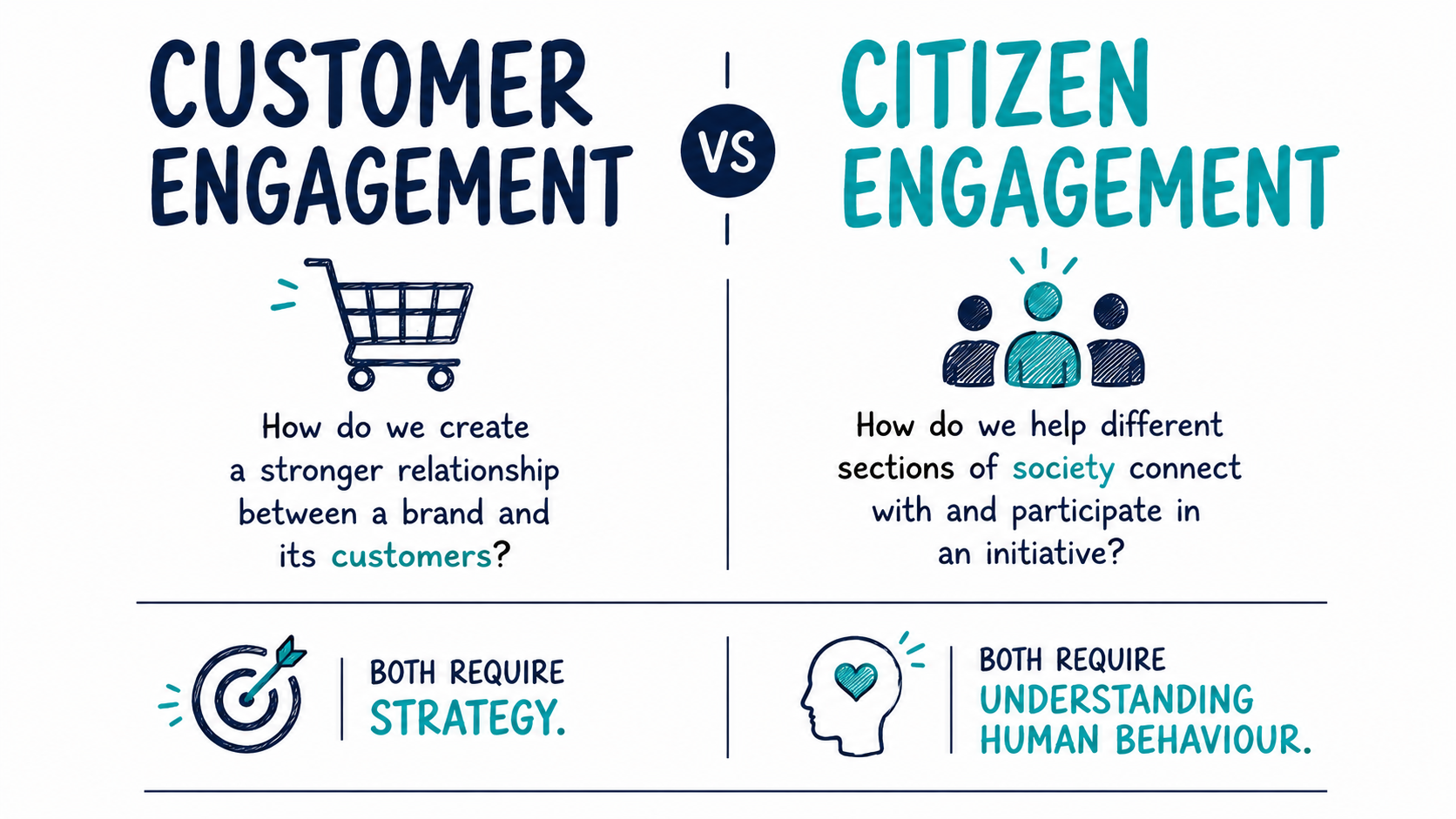
Having led both corporate marketing and public communication initiatives, I noticed something that took me a while to name properly. Customer engagement and citizen engagement use nearly identical tools — social content, campaigns, events, partnerships — and yet the thinking underneath them runs in opposite directions.
Customer engagement starts with a defined offering: a product, a target audience, a value proposition, a business objective. Every piece of communication is designed to pull one type of person toward one relationship — choose the brand, use the brand, stay with the brand. The entire discipline is built to converge a segment of people onto a single script.
Citizen engagement doesn't get that starting point, and more importantly, it isn't supposed to arrive at that outcome either.
The Same Initiative, Read Five Different Ways — On Purpose
Take an environmental initiative to improve a city's green cover. A student sees it as a responsibility toward the future they'll inherit. A family sees it as one more tree to plant and care for together. An educational institution sees an opportunity to build a greener campus. A resident association sees a reason to revive a neighbourhood park.
In a customer engagement model, this would be treated as a segmentation problem to be resolved — narrow down to the highest-value audience, tailor the message, optimise the funnel toward one conversion behaviour. But citizen engagement isn't trying to resolve those five interpretations into one. It needs all five to remain true, simultaneously, permanently. The initiative succeeds precisely because a student, a family, and an institution never need to agree on why it matters to them.
The Hidden Pattern: Convergence Is the Goal in One Model and the Failure Mode in the Other
This is the part most teams miss when they import corporate engagement thinking into a multi-stakeholder context. Customer engagement treats divergent audience interpretations as noise to be reduced — the job is to find the single sharpest message and get everyone onto it. Citizen engagement treats convergence as the actual risk. A single, one-size-fits-all message that tries to mean the same thing to a student, a family, and an institution usually ends up meaning very little to any of them.
The question customer engagement asks is: how do we build a stronger relationship between a brand and its customers? The question citizen engagement asks is: how do we help fundamentally different groups arrive at participation through entirely different reasons? Both are legitimate strategic questions. They just point in opposite directions, and applying one model's success criteria to the other's problem is where most cross-context campaigns quietly break.
Where This Shows Up Beyond Government Work
This isn't only a public-sector distinction. Any B2B sale involving a buying committee runs into the same structural problem — a safety officer, a procurement head, and a plant manager evaluating the same specialty chemical purchase are not persuaded by the same argument, and trying to converge them onto one pitch usually satisfies none of them fully. Internal communications inside a large organization face an identical challenge rolling out one company-wide initiative to functions with entirely different stakes in it. In every case, the strategic move isn't picking the single best message. It's designing several genuinely different, simultaneously true reasons to participate, all pointed at the same outcome.
What This Changes About How Engagement Gets Measured
The practical implication is in what gets treated as success. A customer engagement campaign measures convergence — did enough of the target audience move toward the one intended relationship. A citizen or multi-stakeholder engagement effort measuring itself the same way will read its own success as failure, because five different audiences holding five different reasons for participating isn't a sign the message wasn't sharp enough. It's the strategy working exactly as it needed to.
Engagement isn't one discipline wearing two names. It's two different problems that happen to share a toolkit — and the model built for one will quietly sabotage the other if nobody notices the difference before the campaign is built.